SHOCKING REVELATIONS!

EXPOSING THE TRUTH!

Narrative Breaker

DOCUMENTING MEDIA FAILURES LINE BY LINE

Category: Uncategorized

  • Stephen Glass: The Golden Boy Who Forged Reality.

    Stephen Glass: The Golden Boy Who Forged Reality.

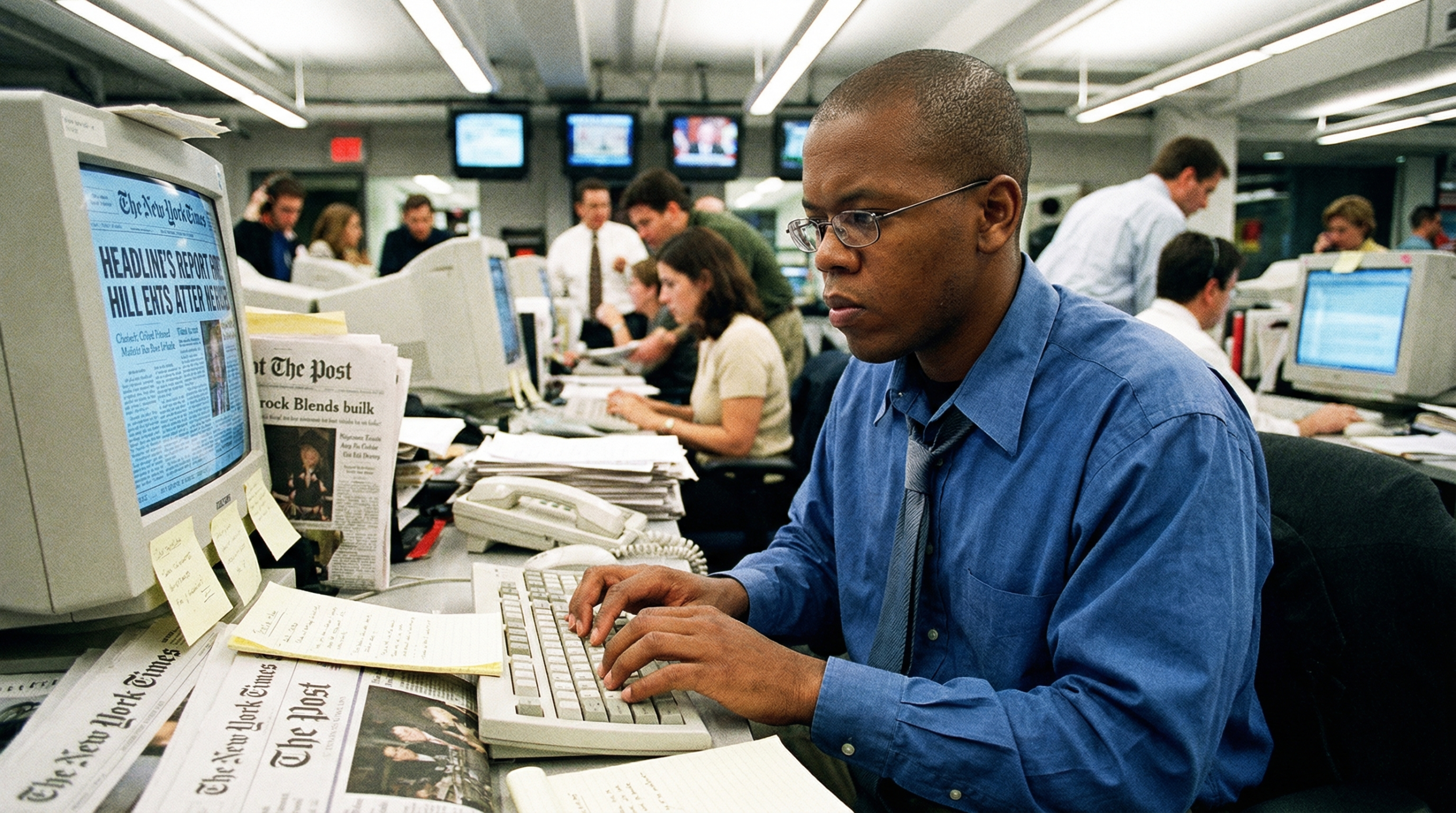
    Young reporter at a cluttered newsroom desk, colleagues leaning in as he types.
    THE GOLDEN BOY Smart, quick, charming. A newsroom loves a prodigy, especially one who never misses.
    Coworkers applaud around a desk in a busy office as a writer smiles in the center.
    PRAISE MACHINE Editors clap. Colleagues beam. The byline becomes a brand that nobody wants to question.
    Writer hunched over a notebook as surreal figures and scenes swirl around him in a newsroom.
    INVENTING REALITY A reporter’s notebook becomes a studio. The world on the page starts getting built from scratch.
    Editors crowd a table with highlighted documents, confronting a seated writer in a newsroom.
    THE QUESTIONS Verification starts. Receipts get demanded. The vibe shifts from applause to scrutiny.
    Writer typing late at night in a dim newsroom with papers, notes, and coffee cups scattered.
    PANIC MODE When the lie wobbles, the work doubles. More details. More props. More cover.
    Two men in a conference room review printed pages under harsh lights, tense and focused.
    RECEIPTS OR ELSE The story is no longer the story. The process becomes the story, and it is unforgiving.
    Staff stand before a wall of headlines and photos connected with red lines, investigating a fraud.
    THE AUDIT WALL One article turns into many. Patterns appear. A talent story becomes a failure story.
    Writer carrying a cardboard box with a plant and files, walking through a newsroom.
    THE BOX When trust dies, the goodbye is not dramatic. It is cardboard, silence, and fluorescent light.
    An empty newsroom desk with a dark monitor, scattered papers, and a press mug.
    AFTERMATH The desk stays. The name goes. The institution keeps moving, and the stain stays with it.

    Stephen Glass: The Golden Boy Who Forged Reality.

    THE GOLDEN BOY Smart, quick, charming. A newsroom loves a prodigy, especially one who never misses. PRAISE MACHINE Editors clap. Colleagues beam. The byline becomes a brand that nobody wants to question. INVENTING REALITY A reporter’s notebook becomes a studio. The world on the page starts getting built from scratch. THE QUESTIONS Verification starts. Receipts…

    HE DID NOT BREAK THE RULES. HE REPLACED REALITY.

    Stephen Glass, The New Republic, and the Most Dangerous Drug in a Newsroom: Being Loved

    Every newsroom has a type.

    The kid who is always early. Always cheerful. Always helpful. The one who laughs at the right jokes and brings a little energy into a fluorescent place that runs on stale coffee and deadline dread.

    Editors trust that type. Not because of evidence. Because of vibe. Because of story. Because of how good it feels to believe you found the next big thing before everyone else did.

    Stephen Glass fit the type so perfectly it should have been suspicious.

    In the 1990s he became one of the brightest rising stars at The New Republic, a magazine that sold itself as smart, plugged-in, and morally serious. Glass was young, ambitious, and weirdly unthreatening. He wrote the kinds of stories editors love because readers love them: vivid scenes, sharp characters, and the punchline truth at the end that makes you feel informed and entertained at the same time.

    His pieces had that cinematic thing. Dialogue that landed. Details that glittered. A sense that he had special access to hidden rooms, private conversations, strange corners of American life where the weird stuff happens.

    And that is where the trap was.

    Because the details were not just polished. Many of them were invented.

    THE RISE: WHY HE WAS UNSTOPPABLE

    Fraud in journalism almost never starts as “I am going to commit fraud.” It starts as pressure mixed with opportunity.

    Pressure: a hungry writer wants to stay hot. The next story has to match the last story. The next story has to pop. The next story has to justify the attention he is getting in the building.

    Opportunity: editors and fact-checkers are busy. The newsroom is moving fast. The publication wants great stories and it wants them now. And when you deliver, people stop questioning how you deliver.

    Glass did not simply write well. He wrote what the system rewarded.

    He found stories that felt like the 1990s: early internet weirdness, political absurdity, corporate idiocy, and culture war freak shows before the phrase “culture war” became a daily weather report. He put readers in the room. He gave them a villain, a punchline, and a moral.

    And inside the magazine, his success was contagious. Great bylines make editors look great. They make a publication feel alive. They create the illusion that you are ahead of the curve.

    Once that feeling exists, it becomes very hard for institutions to give it up.

    THE METHOD: HOW YOU FAKE A WORLD

    The public tends to imagine journalism fraud as one big lie. One made-up quote. One exaggerated detail. A little “creative” reconstruction.

    Stephen Glass was not doing that.

    What made his case infamous is that the fraud was not just in the writing. It was in the infrastructure around the writing.

    When a newsroom fact-checks a story, the checker does not teleport to the scene. They verify through sources, documents, contact info, and confirmation calls. That process assumes something basic: that the reporter is not actively building a fake universe designed to survive verification.

    Glass exploited that assumption.

    When details were challenged, he could provide details. When a person needed to exist, he could point to a person. When a company needed to exist, he could produce a trail. Not because it was real, but because he treated the lie like a production.

    Think about what that means in practice. It means the story is not a story. It is a set.

    A set needs props. It needs names. It needs phone numbers that connect. It needs emails. It needs paperwork. It needs something that looks like reality long enough to pass through a rushed process.

    And once you do that once, it gets easier. The fear drops. The confidence spikes. The lie stops feeling like a lie and starts feeling like “my process.”

    This is why journalism fraud is so poisonous. It is not just the falsehood. It is the manipulation of the institution’s trust systems. It turns verification into theater.

    WHY HE GOT AWAY WITH IT

    The uncomfortable truth is that a newsroom is built to publish, not to prosecute.

    Most verification is designed to catch mistakes, not sabotage.

    So when a writer is charming and productive, people fill in the blanks in his favor. They interpret confusion as complexity. They interpret oddities as quirks. They interpret missing elements as normal friction in reporting.

    And Glass was not a lone actor in a vacuum. He was inside a culture that wanted the story to be true.

    Editors loved the copy. Checkers were pressured by the pace. The magazine loved the buzz. The byline delivered. The incentive gradient pointed in one direction: keep the machine running.

    Also, and this matters, the lie was flattering.

    His stories made the magazine look connected and smarter than everyone else. They made readers feel like insiders. They made the newsroom feel like it was winning.

    Institutions protect what makes them feel successful.

    THE CRACK: WHEN ONE STORY REFUSED TO VERIFY

    Every long-running fraud ends the same way: not with a confession, but with friction.

    A detail that cannot be confirmed.

    A source that does not behave like a source.

    A company that is not where it should be.

    In Glass’s case, outside scrutiny hit one of his stories and the verification trail started to look like a movie set when you tug on the wallpaper. The problem was not just that something felt off. It was that the basic anchors of reality did not hold under pressure.

    That is the moment where a newsroom has only two choices.

    Choice one: rationalize. Pretend the friction is normal. Defend the star. Protect the product.

    Choice two: investigate your own house like it is on fire.

    Once The New Republic started pulling threads, the problem stopped being “this article.” It became “what else.” And “what else” is what destroys institutions, because it forces them to admit they were not merely fooled. They were comfortable being fooled.

    THE FALL: THE AUDIT THAT WRECKED A CAREER

    The myth people like is that fraud is a single reveal and then it is over. In reality, the reveal is the beginning of the worst part.

    Once editors decide the writer cannot be trusted, they have to re-open everything. They have to review past work. They have to test claims, sources, scenes, and the “too-perfect” moments that were previously celebrated.

    And that process does not just find errors. It finds a pattern.

    Dozens of stories become suspect. Corrections become humiliations. Internal conversations become damage control. The newsroom becomes less a newsroom and more a crisis room.

    For Stephen Glass, the persona that protected him also doomed him. The golden boy image made the betrayal feel personal. People were not only angry that the public had been misled. They were angry that they had been played inside their own building.

    And eventually, the ending arrives exactly how the slideshow shows it: not with a gavel, but with a cardboard box.

    EDITOR BREAKDOWN

    The Stephen Glass scandal is not just a story about one writer lying. It is a story about how an institution can become addicted to output, prestige, and narrative pleasure.

    Glass succeeded because he understood the real product. The real product was not “truth.” The real product was “a story that feels true.” He delivered that feeling over and over. The newsroom rewarded him for it. And every reward made the next lie easier to justify and easier to defend.

    The scandal also shows the limits of traditional fact-checking when a reporter is actively committing adversarial deception. A normal process is built to catch mistakes and misunderstandings. It is not built to withstand a reporter who manufactures supporting evidence, crafts a plausible trail, and uses the institution’s own routines against it.

    Most importantly, this case is a warning about personality-based trust. “He seems like a good kid” is not a verification method. “Everyone likes him” is not a source. “He has never messed up before” is not evidence. Those are comforts. Comforts are how fraud lives.

    In the end, the damage was not limited to one magazine. It fed public cynicism about media. It gave every bad-faith actor a fresh talking point. And it proved, in the loudest possible way, that narrative can outrun reality when institutions prefer the rush of a great story over the discipline of a true one.

    TOP 5 MOST EGREGIOUS MEDIA FAILURES

    # What They Did Why It Was Egregious
    1 Treated a star writer as a protected asset Success created a trust bubble where skepticism felt impolite, not necessary.
    2 Relied on routine fact-checking against adversarial deception Systems built to catch honest mistakes can be gamed when someone builds a fake world on purpose.
    3 Let “perfect scenes” pass without demanding hard anchors Too-neat dialogue and cinematic detail should trigger stronger verification, not admiration.
    4 Allowed narrative incentives to overpower verification incentives When speed and buzz matter more than proof, the newsroom becomes easy to exploit.
    5 Underestimated how much public trust gets destroyed by internal failures One fraud becomes a permission slip for distrust, and the whole industry pays the bill.

    He did not need to beat a courtroom. He only had to beat the process long enough for the magazine to print, and that folks, is the narrative breaker.

    Comments

    Leave a Reply

    Your email address will not be published. Required fields are marked *

    MORE POSTS

    NEWEST DROPS • FILED IN PUBLIC

  • When a Lie Wins a Pulitzer: The Janet Cooke Scandal

    When a Lie Wins a Pulitzer: The Janet Cooke Scandal

    Young Washington Post reporter standing in a busy newsroom with notepad and typewriters.
    THE RISING STAR A young reporter quickly earns attention inside the Washington Post newsroom.
    Reporter typing late at night on a typewriter beside stacks of notes and coffee.
    THE STORY Late-night writing sessions produce a devastating story about an 8-year-old heroin addict.
    Editors examining a resume and documents inside a newsroom office.
    THE CRACK Editors begin reviewing credentials and documents that don’t quite add up.
    Reporter smiling on stage receiving a major journalism award.
    THE PULITZER The story wins journalism’s highest prize — and the entire industry applauds.
    Investigators speaking with a resident outside brick row houses.
    THE SEARCH Authorities search neighborhoods trying to locate the child described in the story.
    People reading newspapers on a city street reacting with shock.
    NATIONAL OUTRAGE Readers across the country react with horror to the story of “Jimmy.”
    Reporter sitting alone in a meeting room across from editors.
    THE CONFESSION Under pressure from editors, the reporter finally admits the story was fabricated.
    Pulitzer medal resting on a desk inside a quiet newsroom.
    THE RETURN The Pulitzer Prize is surrendered after the truth collapses the story.
    Empty newsroom desk with award sitting alone in dim light.
    THE AFTERMATH The scandal leaves one of journalism’s most embarrassing ethical failures.

    When a Lie Wins a Pulitzer: The Janet Cooke Scandal

    THE RISING STAR A young reporter quickly earns attention inside the Washington Post newsroom. THE STORY Late-night writing sessions produce a devastating story about an 8-year-old heroin addict. THE CRACK Editors begin reviewing credentials and documents that don’t quite add up. THE PULITZER The story wins journalism’s highest prize — and the entire industry applauds.…

    SHE WON A PULITZER FOR A CHILD WHO NEVER EXISTED

    The Stunning Fraud That Humiliated American Journalism

    The story was devastating.

    An eight-year-old boy in Washington, D.C.

    Hooked on heroin.

    Needles in his tiny arm.

    A childhood already destroyed by addiction.

    The Washington Post called him Jimmy.

    The story felt real. Painfully real.

    Readers were horrified.

    Politicians demanded answers.

    Police began searching the city for the child.

    But there was one problem.

    Jimmy didn’t exist.

    THE STORY THAT WON EVERYTHING

    In 1980, Washington Post reporter Janet Cooke published a feature titled “Jimmy’s World.”

    It described a young boy raised inside Washington’s drug underworld.

    The article was vivid. Cinematic. Emotional.

    Readers believed every word.

    So did editors.

    So did the Pulitzer committee.

    In 1981, Cooke won journalism’s highest prize.

    A Pulitzer Prize for Feature Writing.

    It was a career-defining moment.

    And it would collapse within days.

    THE FIRST DOUBTS

    Authorities tried to find Jimmy.

    They searched neighborhoods.

    They questioned residents.

    No child matched the description.

    The Washington Post initially defended the story.

    Cooke insisted she had protected the boy’s identity.

    But then another problem surfaced.

    Her résumé.

    THE RESUME LIE

    Cooke claimed degrees from Vassar and the University of Toledo.

    The Washington Post checked.

    The records didn’t match.

    If she lied about her background, editors wondered…

    What else had she lied about?

    They reopened the Jimmy story.

    Line by line.

    Detail by detail.

    And it collapsed.

    THE CONFESSION

    Under pressure from editors, Cooke admitted the truth.

    The boy was fabricated.

    The characters were invented.

    The scenes never happened.

    The Washington Post returned the Pulitzer Prize.

    It remains one of the most humiliating scandals in modern journalism.

    TOP 5 MOST EGREGIOUS FAILURES

    # Failure Impact
    1 Fabricated a vulnerable child Exploited public empathy using a fictional victim.
    2 Editors failed to verify sources No one demanded proof the child existed.
    3 Police resources wasted Authorities searched for a victim who was fictional.
    4 Pulitzer awarded before deeper verification The industry’s highest honor amplified the fraud.
    5 Narrative bias over skepticism The story fit cultural fears about drugs, so scrutiny weakened.

    In the end, the scandal became a permanent warning inside journalism: if a story seems too perfect to question, that may be exactly when it should be questioned the most.

    Comments

    Leave a Reply

    Your email address will not be published. Required fields are marked *

    MORE POSTS

    NEWEST DROPS • FILED IN PUBLIC

  • Claas Relotius: The Stories Were Beautiful. The Facts Were Not.

    Claas Relotius: The Stories Were Beautiful. The Facts Were Not.

    A young, confident reporter in a modern newsroom, smiling at his desk with newspapers spread out.
    THE GOLDEN BOY SMART SUIT. CLEAN SMILE. A NEWSROOM THINKS IT FOUND A STAR.
    A reporter stands at a conference table covered in papers and sticky notes, briefing editors.
    THE PERFECT PITCH HE SELLS THE ROOM ON A STORY SO CINEMATIC IT SOUNDS LIKE A MOVIE.
    A smiling journalist on a stage holding an award trophy as confetti falls.
    AWARD MACHINE HE WINS. AGAIN. AGAIN. AGAIN. FOR STORIES THAT HIT EVERY “RIGHT” NOTE.
    A man working late at a laptop with a corkboard of photos, maps, and red string behind him.
    THE LIE FACTORY NOT REPORTING. NOT VERIFYING. ENGINEERING SCENES LIKE A SCREENWRITER.
    An editor on the phone, stressed, with a marked-up printout full of red circles and notes.
    FIRST RED FLAGS EDITORS START CALLING. SOURCES HESITATE. DETAILS DON’T LINE UP.
    A frantic newsroom verification moment: staff huddled over documents labeled confidential.
    VERIFICATION PANIC THE “CHECKING” STARTS AFTER PUBLICATION. THAT’S HOW YOU KNOW IT’S BAD.
    A reporter in the rain surrounded by microphones and cameras as reporters shout questions.
    THE COLLAPSE WHEN THE STORY IS YOU, EVERY QUESTION FEELS LIKE A SEARCH WARRANT.
    An empty office desk with a cardboard box of belongings and coworkers whispering in the background.
    EMPTY DESK THE STAR VANISHES. THE NEWSROOM IS LEFT HOLDING THE DAMAGE.
    A pile of shredded pages, magazines, and a broken trophy beside a headline reading disgraced.
    DISGRACED THE TROPHY BREAKS. THE PAGES TEAR. THE TRUST DOESN’T COME BACK.

    Claas Relotius: The Stories Were Beautiful. The Facts Were Not.

    THE GOLDEN BOY SMART SUIT. CLEAN SMILE. A NEWSROOM THINKS IT FOUND A STAR. THE PERFECT PITCH HE SELLS THE ROOM ON A STORY SO CINEMATIC IT SOUNDS LIKE A MOVIE. AWARD MACHINE HE WINS. AGAIN. AGAIN. AGAIN. FOR STORIES THAT HIT EVERY “RIGHT” NOTE. THE LIE FACTORY NOT REPORTING. NOT VERIFYING. ENGINEERING SCENES LIKE…

    HE WON AWARDS. THEN THEY FOUND OUT HIS SOURCES DIDN’T EXIST.

    The Wild Rise and Nuclear Fall of Claas Relotius

    There are normal journalism scandals. The kind where someone massages a quote, cleans up a timeline, trims a rough edge to make a story read smoother.

    And then there is Claas Relotius.

    Relotius didn’t “polish” reality. He replaced it. He didn’t bend facts. He built entire worlds. He wrote scenes so perfectly composed, so emotionally tuned, so surgically aligned with the moral of the week, that editors didn’t just publish them. They celebrated them.

    He became a star at one of Germany’s most famous magazines. He stacked up prizes. He got the kind of praise most reporters only hear in retirement speeches.

    And the insane part is not that he lied.

    It’s how big the lies were. How cinematic. How shameless. How many people had to not look too closely for the machine to keep printing.

    THE GOLDEN BOY PROBLEM

    Newsrooms love a certain type of writer. The one who always comes back with a perfect opening scene. The one who can make a stranger feel “iconic” in three paragraphs. The one who can turn an issue into a face, a quote, a tear, a punch line, a final line that lands like a judge’s gavel.

    Relotius was that guy. Except the “perfect” wasn’t craft. It was fabrication.

    He didn’t just invent a quote. He invented the person who said it. He didn’t just misremember a detail. He manufactured entire conversations, entire biographies, entire scenes, then wrote them like he had been there, breathing the air.

    And when your stories always deliver maximum emotion with minimum friction, you become useful. You become protected. You become the kind of “talent” nobody wants to slow down with annoying questions like: “Can we call this source?”

    THE FABRICATIONS WERE NOT SMALL

    This wasn’t one bad story. The scandal exploded because the pattern was ugly: multiple pieces contained serious invention. The kind of invention that turns journalism into fan fiction with a corporate logo on it.

    The alleged reporting had the same smell over and over: details too perfect, characters too symbolic, quotes too clean, moral arcs too neatly wrapped. Real life is messy. Relotius wrote like life had a script supervisor.

    And because the stories often “told the right truth” emotionally, the kind that flatters a newsroom’s worldview, they slid through. People didn’t just fail to dispute them. They didn’t want to. The narrative was doing work for them.

    HOW DID IT TAKE SO LONG?

    Here’s the part that should make every editor sweat.

    Relotius worked inside a system that was supposed to catch this. Fact-checking. Editorial oversight. Source verification. Notes. Receipts. Calls. Emails.

    Yet the stories kept coming. The awards kept arriving. The legend kept growing.

    Why? Because institutions get lazy around “stars.” Because deadlines make people cut corners. Because nobody wants to be the villain who slows down the newsroom’s golden goose.

    And because when a piece lands exactly on the emotional pressure points of the moment, it feels “true” in the way that matters most to narrative-driven media: it feels like the lesson you already believed.

    THE COWORKER WHO WOULD NOT LET IT GO

    Every fraud story eventually has the same ingredient: one person who refuses to swallow the vibe.

    In the Relotius scandal, that person was a fellow reporter who started pushing back on details that didn’t make sense, details that couldn’t be verified, details that felt engineered.

    That’s what breaks these cases open. Not genius. Not magic. Skepticism. Persistence. A refusal to accept “trust me” as documentation.

    Once the questions got specific, the whole illusion started to wobble. Once people started calling, checking, demanding proof, the stories couldn’t hold their shape.

    THE FALL WAS INSTANT

    When the scandal finally landed, it wasn’t a gentle correction. It was a crater.

    The “award-winning correspondent” label flipped to “disgraced” overnight. Stories were re-examined. Retractions and internal reviews followed. The newsroom that had praised him had to explain how a man could allegedly fabricate so much, for so long, while being treated like a crown jewel.

    And that is the real damage. Not just that one writer lied. But that the system rewarded the lies with applause.

    EDITOR BREAKDOWN

    This case is a masterclass in how narrative momentum can overpower verification. The reporting was “too good,” too clean, too emotionally perfect, and instead of triggering alarm bells, it triggered praise. The smoother the story read, the less resistance it encountered.

    It also exposed a brutal newsroom weakness: star protection. When someone consistently produces high-impact copy and wins awards, institutions start treating scrutiny as sabotage. Skeptics become “difficult.” Questions become “delays.” Verification becomes “a lack of trust.”

    And the most egregious piece is the cultural incentive: some narratives are so emotionally satisfying that people stop wanting evidence. If a story confirms what a room already believes, the room becomes less curious about whether it happened exactly as written.

    That’s why Relotius matters beyond Germany. It’s a warning label for any newsroom that confuses “powerful writing” with “true reporting.”

    TOP 5 MOST EGREGIOUS MEDIA FAILURES

    # What They Did Why It Was Egregious
    1 Confused “perfect narrative” with proof Stories that read like scripted cinema should trigger verification, not applause.
    2 Let a “star” outrun scrutiny High output and awards created a protective bubble where hard questions were treated like hostility.
    3 Verified too late, or not at all Calling sources and checking details after publication turns fact-checking into damage control.
    4 Allowed worldview comfort to lower standards Narratives nobody wants to dispute become low-res truth: emotionally convincing, evidentially weak.
    5 Rewarded fabrication with prestige Awards don’t just celebrate stories. They certify them. When the certification is wrong, the whole institution bleeds credibility.

    He didn’t need to fool everyone forever. He only needed to fool the system long enough for the trophies to stack up. And once the narrative engine starts printing, the truth has to sprint just to catch the paper.

    Comments

    Leave a Reply

    Your email address will not be published. Required fields are marked *

    MORE POSTS

    NEWEST DROPS • FILED IN PUBLIC

  • Jason Blair: He Wrote the Story. Then They Found Out He Wasn’t There.

    Jason Blair: He Wrote the Story. Then They Found Out He Wasn’t There.

    Early 2000s newsroom: a young reporter types at a desk amid newspapers, CRT monitors, and a busy floor.
    THE RISE A FAST CLIMB INSIDE AMERICA’S MOST POWERFUL NEWSROOM.
    Empty office at dusk: desk, blank monitor, coffee mug, notebook, and city skyline through tall windows.
    THE PRESSURE DEADLINES SQUEEZE. VERIFICATION SLIPS. THE TEMPTATION SHOWS UP.
    Press conference scene: officials speak at a podium surrounded by microphones and flashing cameras.
    THE BYLINE BIG STORIES NEED ‘EYES ON THE SCENE’—BUT THE DETAILS CAN BE FAKED.
    A solitary man walking through a downtown corridor of tall buildings, hands in pockets, serious expression.
    THE DRIFT WHEN FACTS GET THIN, ‘VOICE’ GETS LOUD—AND THE RISK EXPLODES.
    Newsstand scene: a man reads a newspaper with a large headline about a newsroom scandal.
    THE BREAK THE SCANDAL HITS THE STREET—AND THE BRAND TAKES THE BULLET.
    Tense newsroom meeting: editors argue around a table piled with papers and marked-up documents.
    THE AUDIT ONCE EDITORS START PULLING THREADS, THE WHOLE SWEATER UNRAVELS.
    Investigation wall: corkboard covered in articles, notes, photos, and red string connecting evidence.
    THE THREAD PULL PATTERNS EMERGE. SOURCES FAIL. THE RECEIPTS START STACKING.
    Editor compares two printed articles with highlighted passages and handwritten notes indicating overlaps.
    THE RECEIPTS PLAGIARISM. FABRICATION. DATELINES THAT DON’T ADD UP—IN BLACK AND YELLOW.
    Late-night desk: a man works at a laptop under a lamp surrounded by clippings and papers, city lights outside.
    THE AFTERMATH THE BYLINE VANISHES. THE DAMAGE TO TRUST DOESN’T.

    Jason Blair: He Wrote the Story. Then They Found Out He Wasn’t There.

    THE RISE A FAST CLIMB INSIDE AMERICA’S MOST POWERFUL NEWSROOM. THE PRESSURE DEADLINES SQUEEZE. VERIFICATION SLIPS. THE TEMPTATION SHOWS UP. THE BYLINE BIG STORIES NEED ‘EYES ON THE SCENE’—BUT THE DETAILS CAN BE FAKED. THE DRIFT WHEN FACTS GET THIN, ‘VOICE’ GETS LOUD—AND THE RISK EXPLODES. THE BREAK THE SCANDAL HITS THE STREET—AND THE BRAND…

    HE MADE IT UP. AMERICA BELIEVED IT.

    The Jason Blair scandal that embarrassed The New York Times — and taught the whole industry a brutal lesson.

    In the early 2000s, The New York Times wasn’t just a newspaper. It was a national referee. A credibility factory. If something made it onto those pages, the country treated it like it had passed through the fire.

    Then Jason Blair happened.

    He was young, hungry, and moving fast — the kind of reporter who filed quickly, sounded confident on the phone, and always had another story ready. In a newsroom that runs on deadlines, that looks like a superpower.

    Until someone notices the seams.

    THE RISE

    Blair’s byline started showing up on big stories. High emotion. High stakes. The kind of reporting that relies on human scenes — grief, fear, shock — where editors often lean on the reporter’s voice and judgment because the story is moving fast and the events are raw.

    He worked the national file. He wrote with detail. He sounded like he was there.

    But in multiple cases, he wasn’t.

    THE SHORTCUT

    What made the scandal so radioactive wasn’t one error. It was the pattern: fabrications and plagiarism that didn’t just bend reality — they replaced it.

    There were stories with details that didn’t line up. Quotes that couldn’t be verified. Scenes that seemed too perfect. Datelines that raised eyebrows. Passages that looked suspiciously like work already published elsewhere.

    And the worst part is how ordinary it started to look inside the machine: file the story, feed the cycle, move on. The faster the output, the less time anyone has to slow down and challenge it.

    THE TELL

    Every fraud has a moment where reality taps the glass. In this case, outside reporters and editors started noticing overlaps — language that appeared lifted, details that echoed other coverage too closely, and inconsistencies that weren’t explainable by a simple typo.

    Once the newsroom started pulling on those threads, the sweater didn’t just snag. It unraveled.

    THE AUDIT

    The internal review turned into a grinding, humiliating autopsy. Story by story. Dateline by dateline. Quote by quote. You don’t want to do that work — because every confirmed problem forces you to ask the next question:

    How long did we miss this?

    Who knew?

    Who ignored the alarms?

    And here’s the part that should make every editor’s stomach drop: this didn’t happen in a small blog. It happened inside the gold-standard newsroom — where the whole industry expects the tightest controls.

    FRONT-PAGE CONFESSION

    When the scandal broke publicly, The New York Times did something almost unheard of: it published a lengthy, detailed account of its own failures. Not a tiny correction. Not a quiet note. A full-scale admission that the institution’s safeguards had failed.

    That public confession is why this case remains a defining moment. It wasn’t just “a bad reporter.” It was a top-tier system discovering — in front of everyone — that trust can be exploited when oversight gets lazy, distracted, or overly confident.

    THE EXIT

    Blair resigned. But the story didn’t end with a resignation, because the scandal wasn’t contained to his desk. It sparked questions about management, accountability, internal culture, and how warnings are handled when they’re inconvenient.

    Then came the dominoes: senior newsroom leaders stepped down. Not because the paper stopped functioning — but because credibility is the product, and credibility took a direct hit.

    THE FALLOUT

    The scandal landed at a bad time for journalism — when public trust was already fragile and media criticism was gaining cultural steam. A fabrication case inside the nation’s most influential paper became a gift basket for every cynic with a microphone.

    Newsrooms everywhere responded the same way: tighten procedures, verify more aggressively, document sourcing, and treat plagiarism checks like seatbelts — not optional, not “rude,” just necessary.

    Because the real lesson wasn’t “don’t hire a bad reporter.” It was this:

    Prestige is not a fact-check.

    Speed is not truth.

    A good voice is not evidence.

    THE LESSON

    Jason Blair didn’t just embarrass a paper. He exposed an uncomfortable reality: a modern newsroom is an assembly line under constant pressure, and any assembly line can be gamed if the supervisors start trusting output more than process.

    That’s why this story still matters. It’s not gossip. It’s not ancient history. It’s a case study in how fraud thrives: speed, authority, and the human instinct to assume the brand has already done the checking.

    And that’s the scandal’s final sting — it didn’t just fake scenes. It tested the limits of trust itself.

    TOP 5 MOST EGREGIOUS FAILURES

    # What Happened Why It Mattered
    1 Fabrication of details and scenes Readers weren’t just misled — they were given reality that didn’t exist.
    2 Plagiarism / unattributed borrowing It poisoned the integrity of the record and stole credibility from others’ reporting.
    3 Dateline and location inconsistencies “Being there” is the backbone of reporting; faking it breaks the contract with readers.
    4 Editorial oversight gaps and ignored warning signs Small alarms didn’t trigger hard verification until the problem was massive.
    5 Institutional overreliance on speed and trust High output became a shield; process slipped behind performance.

    When a fraud hits a prestigious newsroom, the scandal isn’t just what one reporter did — it’s what the system allowed. That’s the narrative breaker: process over vibes, verification over velocity.

    Comments

    Leave a Reply

    Your email address will not be published. Required fields are marked *

    MORE POSTS

    NEWEST DROPS • FILED IN PUBLIC

  • Richard Jewell: He Saved Lives. Then They Called Him a Bomber.

    Richard Jewell: He Saved Lives. Then They Called Him a Bomber.

    Security guard stands watch at Centennial Olympic Park during the 1996 Atlanta Olympics.
    THE HERO MOMENT A security guard doing his job spots the kind of “nothing” that turns into everything.
    Security guard and police officer stand near an unattended backpack on a bench.
    THE BACKPACK He flags an unattended bag, alerts police, and helps clear people out—minutes before the blast.
    Security guard helps an injured man move through a chaotic scene with smoke and emergency lights.
    AFTERMATH The bomb goes off—dead, injured, panic—yet far fewer casualties than there should’ve been.
    Security guard speaks to reporters while multiple cameras and microphones surround him.
    HERO HEADLINES For a brief moment, the press calls it straight: lives were saved—and he’s the reason.
    Photographers swarm outside a home at night with flashing lights and law enforcement presence.
    THE LEAK An FBI “profile” leaks. A theory becomes a storyline. The cameras arrive like it’s a verdict.
    Man sits alone watching television beside a stack of newspapers, looking distressed.
    TRIAL BY TV No charges. No arrest. Just nonstop insinuation—until the public memory hardens.
    Man walks outside a courthouse while reporters follow, a headline behind him reads cleared of suspicion.
    CLEARED Officials say he’s no longer a target—yet the exoneration never hits as loud as the accusation.
    Man sits alone on a park bench at dusk, looking down, with newspapers scattered nearby.
    THE DAMAGE Even when the facts catch up, the stigma lingers—because narrative momentum is hard to reverse.

    Richard Jewell: He Saved Lives. Then They Called Him a Bomber.

    THE HERO MOMENT A security guard doing his job spots the kind of “nothing” that turns into everything. THE BACKPACK He flags an unattended bag, alerts police, and helps clear people out—minutes before the blast. AFTERMATH The bomb goes off—dead, injured, panic—yet far fewer casualties than there should’ve been. HERO HEADLINES For a brief moment,…

    HE SAVED LIVES. THEN THEY CALLED HIM A BOMBER.

    The Wild Rise and Crushing Fall of a Reluctant Hero

    On a humid July night in 1996, the world was watching Atlanta.

    The Olympics had turned Centennial Olympic Park into a global stage — flags waving, music blasting, tourists snapping photos under neon lights. It was supposed to be a celebration. A victory lap for the city.

    And standing quietly in the middle of it all was a stocky, mustached security guard doing his job.

    He noticed something.

    A backpack.

    Unattended. Heavy. Out of place.

    That moment — that split-second decision to take it seriously — changed everything.

    Because inside that backpack was a pipe bomb.

    And because he spotted it.

    And because he alerted authorities.

    And because he helped clear the area.

    People lived who otherwise might not have.

    When the bomb exploded, it tore through the park. Two people died. Over a hundred were injured. Panic ripped through the crowd.

    But it could have been worse.

    Much worse.

    And for a few shining days, the headlines said exactly that.

    “SECURITY GUARD HERO.”

    “LIVES SAVED.”

    “QUIET MAN PREVENTS MASS CASUALTY.”

    He gave interviews. Soft-spoken. Awkward. Almost shy. He seemed overwhelmed by the attention.

    America loves a hero story.

    Until it doesn’t.

    THE TURN

    Just three days later, the mood shifted.

    A leak.

    That’s all it took.

    An unnamed “law enforcement source” told reporters that the FBI was looking at the guard himself as a possible suspect. He fit what agents described as a “lone bomber” psychological profile: a frustrated man who might plant a device to later “discover” it and become a hero.

    That theory — speculative, unproven — hit newsrooms like gasoline on a fire.

    And then it exploded.

    The words “person of interest” appeared.

    Then “suspect.”

    Then something worse: insinuation.

    TV vans lined the street outside his modest apartment. Helicopters hovered overhead. Microphones shoved into neighbors’ faces. Every detail of his life was dissected on national television.

    He lived with his mother.

    He had once failed to get hired as a police officer.

    He had reportedly taken law enforcement too seriously in past jobs.

    Suddenly, these were not quirks. They were “clues.”

    Cable news panels debated his psychology.

    Newspapers ran front-page stories suggesting motive.

    Commentators asked whether his “heroism” was staged.

    For 88 excruciating days, he was tried — not in a courtroom — but in living rooms across America.

    TRIAL BY MEDIA

    The search of his apartment was televised.

    Agents carried out boxes.

    Reporters speculated about bomb components.

    Pundits nodded gravely.

    But here’s what didn’t happen.

    He was never charged.

    No indictment.

    No arrest.

    No formal accusation.

    The FBI had a theory. That’s all.

    But the media treated it like a conclusion.

    Some stories blurred the line between investigation and guilt. Others crossed it outright.

    His mother answered the phone and heard strangers screaming.

    His reputation collapsed overnight.

    Job prospects evaporated.

    Friends withdrew.

    The word “hero” was quietly replaced with “suspect.”

    The psychological toll was crushing.

    He later said he felt like he was living inside a fishbowl — every movement scrutinized, every silence interpreted.

    And the most brutal part?

    The actual bomber was still out there.

    THE REAL BOMBER

    Months later, the investigation shifted.

    Then years later, the truth became undeniable.

    The actual perpetrator was Eric Rudolph — a domestic extremist who carried out multiple bombings, including the Atlanta attack.

    The case against the security guard unraveled.

    In October 1996, federal officials formally informed him he was no longer a target.

    Cleared.

    Exonerated.

    Free.

    But was he?

    EDITOR BREAKDOWN

    Even after he was officially cleared, the damage to his reputation never fully disappeared. Some media outlets issued corrections or settled lawsuits, but the public image had already hardened. For many Americans, the suspicion stuck longer than the facts.

    The problem wasn’t evidence — it was narrative. Once an FBI leak suggested he fit a psychological “hero bomber” profile, the story took on a life of its own. Every action was interpreted through that lens. Neutral behavior became suspicious. Silence became strategy. A theory became a storyline.

    The media environment of 1996 — driven by the exploding 24-hour news cycle — rewarded speed and sensational angles. The idea of a “false hero” was dramatic and irresistible. Anonymous sources fueled coverage, and speculation filled airtime.

    Within days, a man who had helped save lives was transformed into a national suspect. And once that shift happens publicly, it is almost impossible to reverse.

    Though he was legally exonerated and later received settlements, the suspicion lingered in public memory. His story became a lasting example of how media momentum can outpace due process — and how headlines can inflict damage long before facts catch up.

    In the end, the case wasn’t just about a bombing. It became a warning about what happens when narrative overtakes evidence.

    TOP 5 MOST EGREGIOUS MEDIA FAILURES

    # What They Did Why It Was Egregious
    1 Reported the FBI leak as a near-conclusion A speculative investigative theory was treated like established fact, instantly flipping him from hero to suspect nationwide.
    2 Framed “person of interest” as implied guilt Headlines and tone blurred the legal line between investigation and accusation, shaping public opinion before any charges existed.
    3 Amplified the “hero bomber” psychological profile A dramatic but unproven theory became the narrative backbone, encouraging viewers to interpret everything through a guilt lens.
    4 Saturated coverage outside his home Cameras, helicopters, and live broadcasts turned a private citizen into a spectacle before he was ever charged with a crime.
    5 Failed to match accusation volume with exoneration coverage The clearance never received the same intensity as the suspicion, allowing the false association to linger in public memory.

    They didn’t need a conviction to destroy him — they only needed a storyline to repeat, and that folks, is the narrative breaker.

    Comments

    Leave a Reply

    Your email address will not be published. Required fields are marked *

    MORE POSTS

    NEWEST DROPS • FILED IN PUBLIC